
Over the years, certain exhibitions stand out for breaking new ground in scholarship or expanding public interest:


BERTHE WEILL : ART DEALER OF THE PARISIAN AVANT-GARDE
“Berthe Weill: Art Dealer of the Parisian Avant-Garde” is the first international exhibition to address the gallerist’s overlooked role in the history of twentieth-century Modernism. Over a career of more than forty years, including two World Wars and the Great Depression, Weill (1865-1951) organized over 400 exhibitions featuring more than 350 artists. Her gallery’s exhibition catalogues are filled with recognizable names such as Matisse, Picasso, and Modigliani, as well as others barely known today. Weill’s forward-thinking vision promoted artists who later became the principal actors of the major art movements of the twentieth century: Fauvism, Cubism, Ecole de Paris, Figuration, and Abstraction. Her unrelenting dedication to exhibiting works by young, unknown, living artists garnered success and international fame for some; yet, for herself, created a lifetime struggle for financial stability that shrouded her successes, overshadowing her actual record of achievements.
The Weill exhibition took years to organize. More than a decade ago, Julie Saul (1954-2022) —a well-established New York gallerist of contemporary photography—came into my office at The Metropolitan Museum of Art with a novel idea.
She wanted to mount an exhibition to evaluate objectively the role of the Parisian art dealer Berthe Weill in the promotion of Modernist art; Saul had been intrigued by a 1995 reference claiming that “only one gallery truly specialized in twentieth-century art—the Galerie Berthe Weill.” Except for Weill’s 1933 memoir, little information was then known about the enigmatic gallerist, and no such exhibition had ever been mounted.
Despite many setbacks, Saul’s proposal to challenge the historical record eventually became a reality through the international partnership formed by three participating museums in the United States, Canada, and France, whose engagement assured the realization of such a ground-breaking endeavor. Today, the press reviews for this exhibition underscore how this forgotten figure—who changed the course of art history—has finally been recognized for her vital role in the creation of the international market for avant-garde art in the twentieth century.
Starting from my first meeting with Saul to the completion of this project, I served as a research consultant and contributed to the catalogue with an essay focusing on Weill’s clients: “Early Modernist Collectors of the Galerie B. Weill”, likely the first text on the subject to be published.
Grey Art Museum, New York
(October 1, 2024 – March 2, 2025)
Musée des Beaux-Arts, Montréal
(May 10 – September 7, 2025)
Musée de l’Orangerie, Paris
(October 8, 2025 – January 26, 2026)
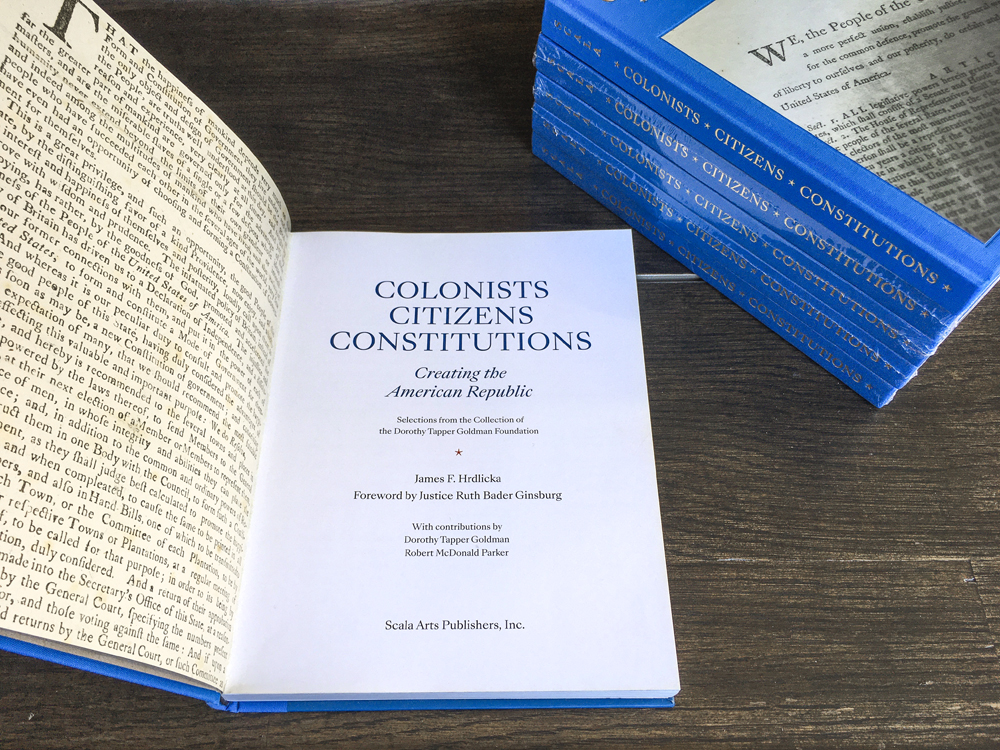
COLONISTS, CITIZENS, CONSTITUTIONS
New-York Historical Society, New York
(February 28, 2020 – March 7, 2021)
For nearly 250 years, America’s ongoing experiment in self-government has defined our nation. Selections of federal and state constitutional materials from the collection of Americana of the Dorothy Tapper Goldman Foundation reveal the debates that have united and divided America over the course of the country’s history and show how Americans have exercised their constitutional powers to create and preserve democracy in an ever-changing society. From the early days of the American Revolution to the eve of World War I, the rare and early printings of state and federal constitutions of this collection trace critical moments in American history.
“Colonists, Citizens, Constitutions” brings together one of few surviving copies of the original Dunlap and Claypoole 1787 printing of the U.S. Constitution and related documents of major historical significance, rarely seen and exhibited together. These include the Virginia Declaration of Rights of 1776; the Articles of Confederation and Perpetual Union, 1777; and two early versions of the Bill of Rights. Other carefully selected materials illustrate the often overlooked importance of state constitutions, particularly with regard to race, gender, and voting rights that have and continue to impact changes to the federal constitution. Rare manuscripts and little-known documents such as an 1838 constitution of the Choctaw Nation and a 1910 bilingual constitution for New Mexico provide additional reminders of our country’s diverse and unique history.
As director of the project, I coordinated the realization of this multiple-venue exhibition and the accompanying catalogue for the first public viewing of these privately-owned documents. The catalogue was written by Dr. James F. Hrdlicka with a foreword by the late Justice Ruth Bader Ginsburg. I also contributed an essay “Collecting Evidence: The Making of an American Collection” that discusses the role of the collector and the dealer in the genesis of this unique collection.
New-York Historical Society
(February 28, 2020 – March 7, 2021)
Museum of the American Revolution, Philadelphia
(June 12 – September 2021)

ESPRIT MONTMARTRE
Schirn Kunsthalle Frankfurt
(February 7 – June 1, 2014)
The artistic life in Montmartre around 1900 thrived in an environment of poverty, crime, prostitution, and drugs. “Esprit Montmartre: Bohemian Life in Paris around 1900” focuses on nearly 200 artworks that were created by known artists such as Toulouse-Lautrec, Edgar Degas, Vincent Van Gogh, and Pablo Picasso, as well as lesser known figures such as Louis Anquetin and Ramon Casas. In their depictions of the cafés, cabarets, and dance halls of Montmartre, their artworks expose the harsh reality of the times. The exhibition dispels many myths of the frivolous joys of the “Belle Epoque” to reveal the dark social cloud under which many of those in Montmartre lived.
Despite the neighborhood’s fervent crime and poverty, the artists overcame these obstacles to create some of the most revered works of the early twentieth century.
The catalogue is a compilation of scholarly essays including my own which focuses on Picasso’s artistic output at the Bateau-Lavoir: “Picasso and Montmartre: Fertile Grounds for Artistic Creation.”

THE STEINS COLLECT
The Metropolitan Museum of Art, New York
(February 21 – June 3, 2012)
“The Steins Collect: Matisse, Picasso, and the Parisian Avant-Garde” is an exhibition related to the artworks acquired by the family of Gertrude, Leo, and Michael and Sarah Stein. Featuring works by many of the artists who defined the twentieth century, the exhibition is a tribute co this Jewish-American family who promoted modern art through their passion for collecting. Their Parisian apartments were home to legendary Saturday-evening salons, where artists, writers, collectors, as well as other notables and society figures flocked to experience modem art first hand.
I was brought into this project to document the family’s collection and to establish an extensive inventory of their holdings of Western art, now published.
The exhibition and accompanying 492-page catalogue were produced by a team of curators and specialists in conjunction with the San Francisco Museum of Art, the Réunion des musées nationaux, and The Metropolitan Museum of Art, where the exhibition was on view from February 28 until June 3, 2012. Published by the San Francisco Museum of Modern Art in association with Yale University Press, New Haven and London, the catalogue is now considered a reference volume for critical study of Modernism and the Steins and is still available.
San Francisco Museum of Modern Art
(May 21-September 6, 2011)
Réunion des Musées Nationaux, Grand Palais, Paris
(October 3, 2011-January 16, 2012)
Awarded
“ Most Outstanding Thematic Exhibition ”
by The Association of Art Museum Curators in 2011.
“ Most Outstanding Exhibition Catalogue Published in 2012”
by the DEDALUS Foundation.
“ Distinguished Publication in the History of Collecting in America”
by The Frick Collection in 2015.
https://www.frick.org/sites/default/files/pdf/center/Fall2015SteinsCollectannouncement.pdf

EXHIBITION CATALOGUE
THE STEINS COLLECT, published in association with Yale University
Press, New Haven and London
GALLERY VIDEO
The study and selection of archival photographs for the catalogue provided the necessary documentation for the creation of a video room in the opening gallery of the exhibition at The Metropolitan Museum of Art in New York. See “The Stein Residences in Photographs” in The Steins Collect.
The Stein Collection as revealed in archival photographs 27, rue de Fleurus from 1904-1934.
FILM AND TELEVISION
The documentary film “La famille Stein, la fabrique de l’art modern/ The Stein Family, The Making of Modern Art” produced by Elizabeth Lennard for Artline Film in 2011 appeared on television in Europe. An extract of interviews and of my research trip to Gertrude Stein and Alice B. Toklas’s rented house in Bilignin are featured herein.

MAGAZINE
The published inventory of 442 artworks, a scholarly apparatus, and some of the discoveries were referenced in my article: “The Steins Collect: Cues, Clues, and Discoveries,” for Fine Books & Collections (Spring 2012).